It’s Not What You Weigh, It’s How Tall You Are
Here’s a fact that genuinely surprised me: the amount of ash left after cremation has almost nothing to do with how much a person weighs. Fat and muscle burn away completely in the intense heat of the retort. What’s left behind is bone, specifically the mineral content of the skeleton.
That means height is actually the best predictor of how much ash a person will produce. A tall, lean person will leave behind more remains than a shorter, heavier person, because taller people simply have more skeleton. Men tend to produce around six pounds of ash on average, while women produce closer to four. Not because of weight differences, but because men generally have denser, larger bone structures.
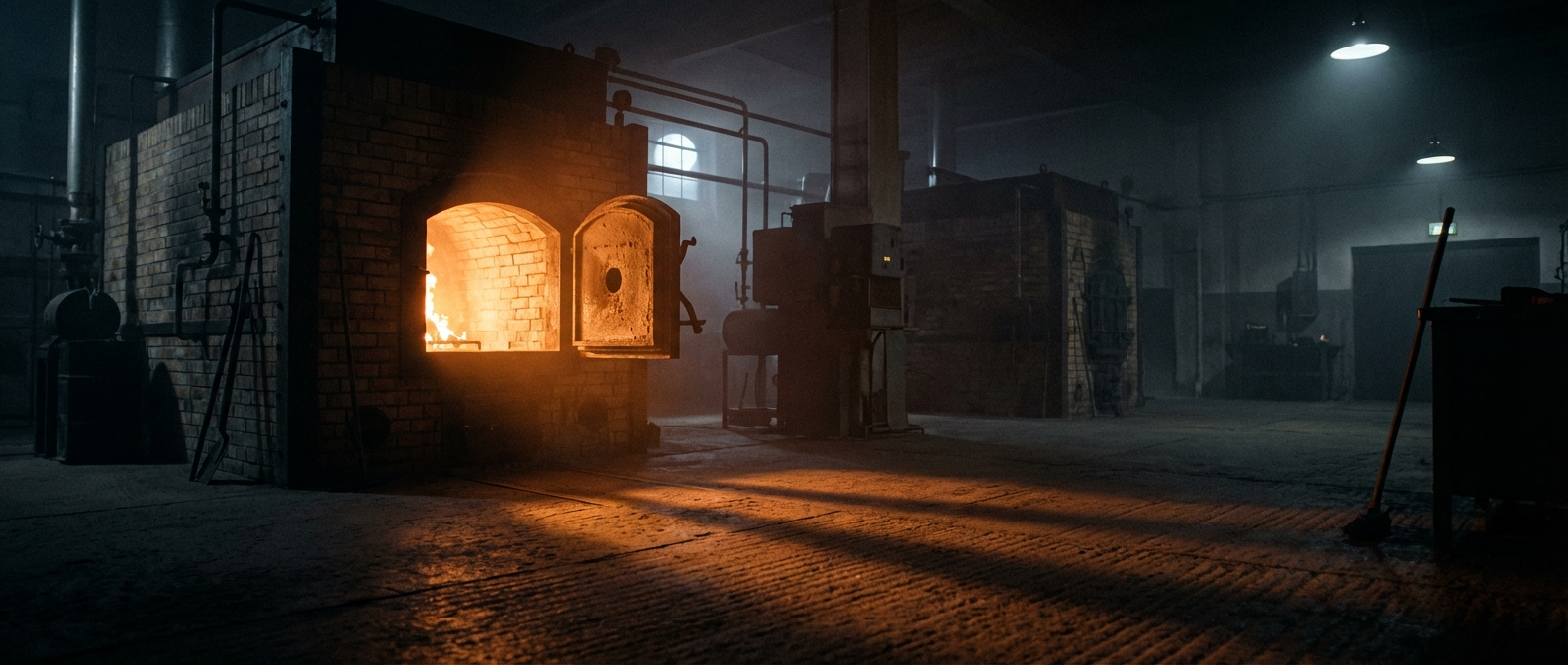
This little nugget of information blew my mind and ended up shaping how I thought about the crematorium scenes in the book. It’s the kind of detail that makes a setting feel real.
The Exploding Pacemaker Problem
If you’ve read Gideon Bean, you might remember the moment when Gideon hears thumping from inside one of the ovens and his first panicked thought is that someone left a pacemaker in a body. That scene came directly from my research.
Pacemakers contain lithium batteries, and when those batteries are exposed to the extreme heat of a cremation chamber (we’re talking 1,400 to 1,800°F), they explode. And not in a small, polite way. The first recorded pacemaker explosion during cremation happened back in 1976.. The blast was powerful enough to damage the brickwork lining of the chamber. Studies have found that roughly half of all crematoria in the UK have experienced at least one pacemaker explosion.
That’s why cremation paperwork specifically asks whether the deceased had a pacemaker, and why it’s required to be removed before the body goes into the retort. In Gideon’s world, a missed pacemaker means weeks of expensive repairs and a very angry boss, which is exactly the kind of real-world headache I wanted to weave into his story.
Silicone Implants: Sticky Situation
Pacemakers aren’t the only things that need to come out before cremation. Silicone implants, breast implants in particular, don’t simply burn away like organic tissue. Instead, they melt and can explode, leaving behind a gooey, sticky residue that coats the ashes and the inside of the chamber. It’s a mess to clean up and can contaminate the remains.
This is why cremation authorization forms ask about implants. The funeral home or cremation service handles the removal. It’s one of those details that sounds almost comical until you realize someone actually has to deal with it, and that “someone” is often a night-shift worker not unlike Gideon.
What “Ashes” Actually Are
Before my research, I pictured cremation ashes as, well… ashes. Like the fine, powdery gray stuff left behind in a fireplace. Turns out, that’s not quite right.
What comes out of the retort after cremation are bone fragments, recognizable chunks of calcified skeleton. These fragments then go through a machine called a cremulator (yes, that is the real name, and yes, I love it), which grinds them down into a coarse, sand-like texture. That’s what families receive.
In the book, I made sure to include the cremulator in Gideon’s workflow. He sweeps the bone fragments and ash into a receptacle, runs a high-powered magnet over the remains to catch any metal bits that could damage the cremulator, grinds everything down, and boxes it up. It’s a whole process, and getting those details right was important to me.
Metal Detectors and Magnets
Speaking of metal bits: the magnet step is crucial. After cremation, the remains can contain all sorts of metal: surgical screws, pins, hip replacements, dental work, you name it. A strong magnet catches most of it, and anything bigger gets removed by hand. Some crematoriums even use handheld metal detectors on bodies before cremation to catch undisclosed implants.
All that reclaimed metal doesn’t just get tossed, either. Companies exist that specialize in recycling metals recovered from cremation. A Dutch company called OrthoMetals reportedly processes over 250 tons of post-cremation metal annually. Those old hip replacements might end up in a car or a wind turbine someday.
Making the Mundane Matter
Of all the research I did, the fact that stuck with me the most was how routine the job is for the people who do it. Crematorium workers describe their job the way anyone might describe a night shift at a warehouse. It’s physically demanding, repetitive, and occasionally weird. They have their rhythms, their shortcuts, their pet peeves about sloppy paperwork from the coroner’s office.
And that’s exactly what makes the premise so funny. Gideon isn’t a supernatural investigator or some chosen one. He’s a regular guy with earbuds in, humming along to indie rock, shuffling bodies into ovens and thinking about flirting with the girl at the Publix deli counter. The crematorium isn’t spooky to him √ it’s just work. The tourists at his day job at Sheryl’s Shell Shack are scarier than the corpses.
So when he hears that first thump from inside the oven, his immediate thought isn’t “oh no, a supernatural creature!” It’s “oh crap, somebody left a pacemaker in.” Because that’s what would actually ruin his night. That’s a real problem with real consequences – an angry boss, a damaged oven, weeks of repairs. The fact that the actual situation is about a thousand times more insane than a forgotten pacemaker is what makes the scene work.
All that research gave me the tools to build Gideon’s completely normal, completely mundane world; so that when a naked woman with wings of fire kicks open the oven door and asks “Did I die again?”, the contrast is as hilarious and chaotic as I’d always imagined it.
So the next time someone asks me where I get my ideas, I’ll tell them: it started with a phoenix and a very unfortunate crematorium worker, and ended with me knowing way too much about exploding pacemakers and bone-grinding machines. Normal author stuff.
Gideon Bean is available now. If you want to see what happens when the most boring night shift in Florida goes spectacularly sideways, grab a copy.