Ireland
Ireland in this novel is a character unto itself — ancient, unassuming, and quietly saturated with magic that the modern world has mostly forgotten about or paved over.
Sophie arrives expecting tourist infrastructure and finds instead a country where portals to other dimensions sit in cow pastures behind unlocked gates, and the entrance to the literal Underworld is a muddy two-foot hole hidden under a hawthorn tree that you could walk right past without noticing.
Sligo is their home base — a small town of brick-laid sidewalks and squat, flat-faced buildings crammed together side by side, radiating a sense of age that makes San Francisco feel like a younger sister who's too big for her britches. The Garvoge River (which everyone calls the Sligo River) flows through town past shops, houses, and many pubs, emptying into Sligo Bay.
Rhydian's running tour focuses on which restaurant has the best curry takeaway and which coffee shop is overpriced, and the group stays in studio apartments above a wolfhound shifter clan pub where the rooms face the river. The Sligo Abbey, built in the thirteenth century, is five euros to tour and mentioned almost as an afterthought — that's how casually ancient this place is.
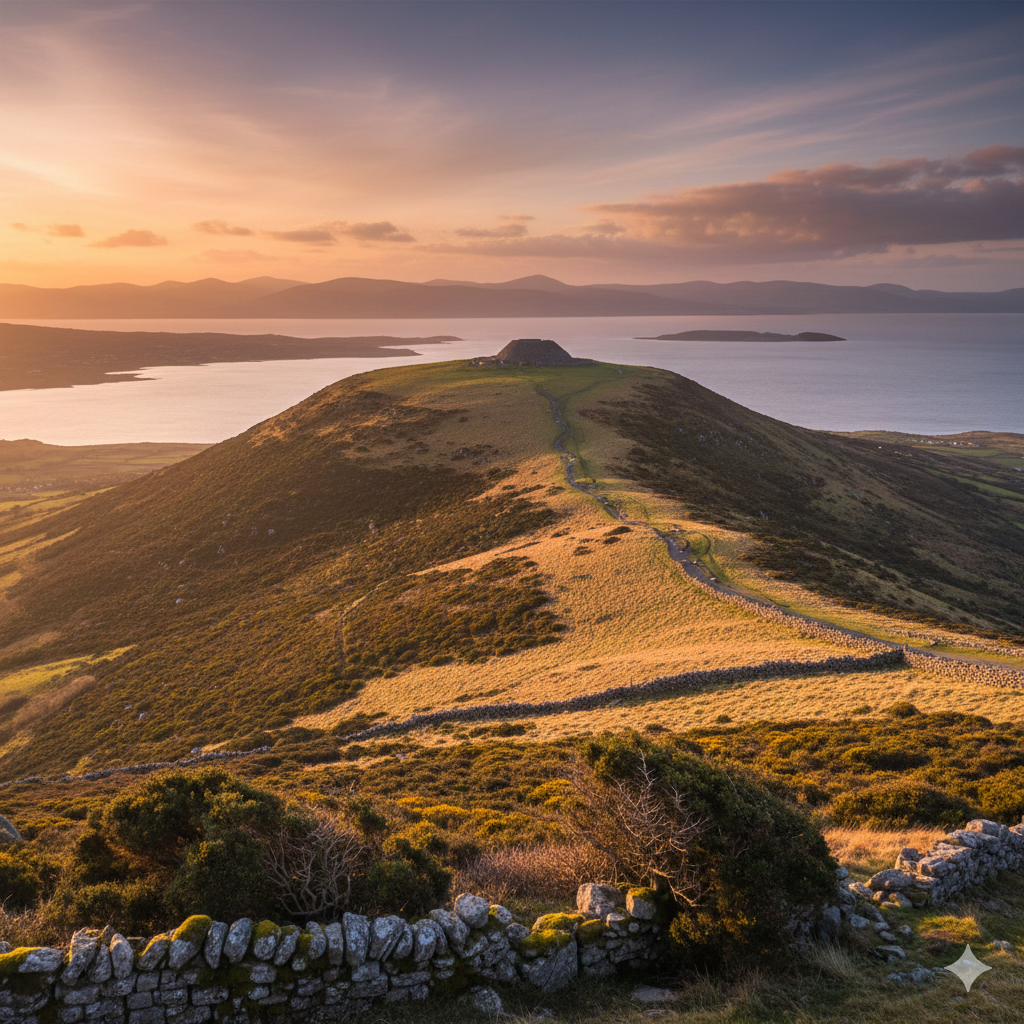
Knocknarea dominates the skyline — a strange flat-topped limestone mountain formed by glaciers, rising alone from the surrounding landscape with no range attached to it. The hike starts across the street from the Sligo Rugby Club (two euros in the honesty box), through fields so impossibly green they look like someone cranked up the saturation — the Emerald Isle earning its name.
The path winds past patchwork-quilt pastures delineated by dark hedges, fluffy black-faced sheep that Ruby tries desperately to befriend, and a derelict ancient stone cottage with its roof long gone but its walls still standing.
The ascent passes through a coniferous woodland that Ruby compares to the scene where Boromir dies (earning Sophie's undying irritation for calling him "that guy"), across a slippery bog bridge, and up to a summit with panoramic views from the wild Atlantic coast to distant Benbulbin.
The cairn itself sits on top — over thirty feet tall, the second-largest in Ireland, a monolithic pile of thousands of rocks lugged up the mountain millennia ago to honor whoever's buried inside, still unexcavated. Strandhill beach is visible in the distance, with black dots of surfers bobbing in the freezing water. Creevelea pulls double duty.
The ironworks is practically a ruin reclaimed by the jungle — all that's left is a single blast furnace that looks like a two-story red-brick vase being swallowed whole by vines, lichen, moss, and a small tree growing from its top lip. Sophie crawls inside the belly of the furnace and looks up at a bright circle of light overhead like the bottom of a well.
The Creevelea Friary, meanwhile, is a former Franciscan monastery (the last built in Ireland before Henry VIII dissolved them all) with stone carvings of Saint Francis still intact inside the cloister.
Its graveyard progresses from elaborate Celtic crosses near the entrance to increasingly crude, ancient headstones further in — and in a far corner, slightly apart from the rest, sits Róisín's lonely round-topped grave, carpeted in white heather, pulling Sophie toward it before she even knows whose it is. Rathcroghan is the most improbable of all.
Laura describes it as over two hundred archaeological sites surrounding a main royal stronghold — the birthplace of Halloween, where people once dressed as Arawn's ghastly beasts during Samhain so he wouldn't accidentally drag them to the Underworld. But when they arrive, it's a rutted lane ending at a gated field full of livestock.
The Oweynagat Cave — the gate to the Otherworld, the mouth of "hell" — is an upside-down triangle of a hole barely two feet across, hidden under low-hanging branches at the base of a three-foot ridge. Róisín is devastated: where there were once temples, altars, and a massive compound, there are now sheep lazily chewing grass.
The only marker is one tiny sign set off to the side like an afterthought. And yet the magic in the soil is still so potent that Laura's dowsing pendulum spins in erratic circles like a drunken clock.
The overall effect is a country where the extraordinary hides in plain sight behind the utterly ordinary — where you park at a rugby club to climb a mountain tomb, close the gate behind you so you don't let out the cows on your way to unlock a portal to the afterlife, and the most significant archaeological sites in the world just sit there in fields, unguarded and unnoticed, waiting for someone who knows what to look for.