Savannah
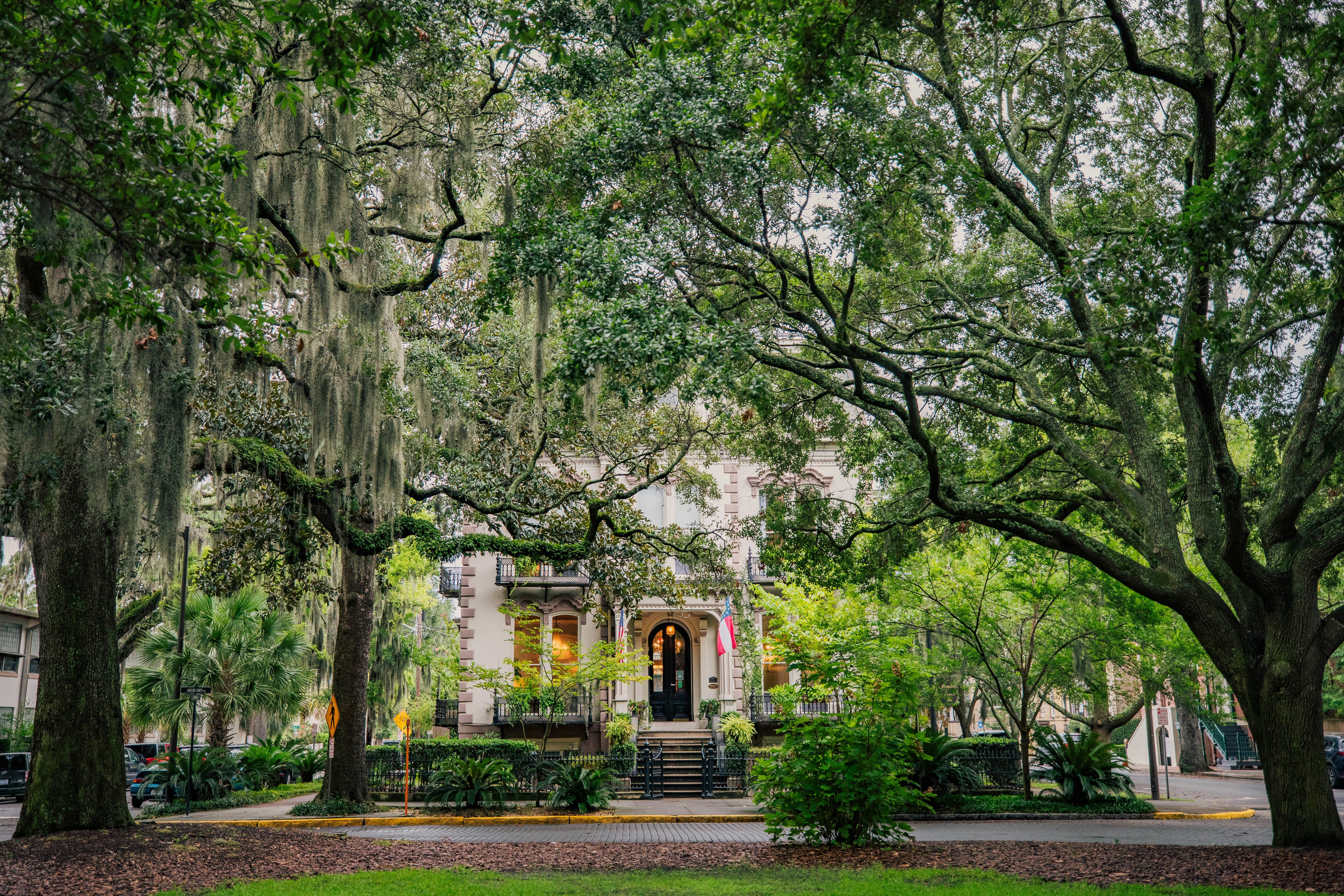
Known as America's first planned city, Savannah, Georgia, features a unique grid layout filled with moss-draped oak trees and historic public squares.
Books Set Here (1)
About This Location
Savannah is a city that has been sitting for its portrait for three hundred years and knows exactly which angle to give you.
The historic district is old and dense and close. The streets narrow, the live oaks meet overhead, and the sunlight comes down through the branches in bright coins on the brick. Spanish moss hangs off everything in long gray beards. Every few blocks the grid opens into a square – a small shaded park ringed with iron fences and monuments gone dark with age – and then closes again. Tourist trolleys crawl the streets while the guide’s amplified patter about ghosts and murders drifts back over the traffic. Horse carriages clop across the intersections.
To an auramancer, the city hums. Generations of spells are layered into the foundations of the row houses. Glamours stretch over the faces of certain shops. Protective wards are worked into the iron fences of certain homes, and the squares themselves hold magic stacked one layer on another, some of it strong and recent, some so faded it’s barely a hint. Savannah is old, and the magic in it is older.
The Brenner house sits on one of the squares, two stories of rust-red brick with a crenellated roofline like a very small, very elegant castle, wrapped in a cast-iron veranda so ornate it looks like black lace. Its neighbors wear their money politely. The Brenners don’t bother. Every hearth in the house burns without a log in it. (The house is modeled on the Green-Meldrim House on Madison Square, built in 1853 and briefly General Sherman’s headquarters. It belongs to St. John’s Episcopal Church now and is open to visitors, when church events allow.)
Drive west out Ogeechee Road and the city gets functional and interchangeable – a vape shop, a self-storage lot, a discount flooring store, an auto parts store with a kudzu-choked chain-link fence out back. Behind that fence, past a padlocked gate that opens for the right silver disc, a dirt lane winds through the oaks to a small brick ruin with square teeth along the top of its walls. This is the Old Powder Magazine, and it’s real: built in 1898 to keep the city’s black powder and dynamite a safe distance from anybody’s house, the only surviving municipal powder magazine in Georgia, added to the National Register in 2025, and closed to the public because it’s roofless and unstable. Please admire it from the road.
What the book puts behind it is not real, and the ruin is there to hide it. The Savannah Conclave’s headquarters is a three-story white-columned mansion with stacked porches and black shutters, glamoured seven layers deep so that mundane eyes see nothing but pines and saw palmetto. Inside, it’s a modern office building with a vestibule, a reception desk, and a basement armory. Upstairs, under the eaves, the old house shows through in plaster walls and iron bedframes. Its design borrows from Nottoway in Louisiana, an enormous 1859 house that burned to the ground in May 2025. Thane will tell you the Conclave built it and it was never a plantation. Gideon still doesn’t like standing in front of it. That discomfort is on purpose.
Twenty minutes south, past the last of the suburbs, the land flattens out into salt marsh. The road crosses the Skidaway Narrows on a long bridge, and from the top of it you can see for miles in either direction – cordgrass in waves of gold and green, tidal creeks curling through it like veins, a heron standing one-legged on the flats. The tide turns twice a day, and the book’s timeline is stitched to it: creeks that were wide brown channels on the drive out are thin bright ribbons on the way back, and the smell of pluff mud comes in through the cracked window, thick and sulfurous and alive.
On the far side of the bridge is The Landings on Skidaway Island, a gated community with a guard at the gatehouse, big lots full of trees, and houses that back onto the golf course or a dock reaching out into the marsh. It is not what Gideon pictured when he pictured sorcerers. That’s rather the point. Old money in Savannah lives on the squares. New money lives out here, and both of them have been warding their property for generations.
North of the city, where the Savannah River meets the port, the harbor cranes stand over the container yards like enormous wading birds with their necks bent to the water. Ships the size of physics violations sit at the dock. Then the road runs out into pine forest, and the houses get small and far apart, and some of them sit at the end of a crushed-shell drive with no neighbors at all.
Savannah is a strange, beautiful, haunted place. In this book, most of the haunting is real.
If You’re Headed That Way
A few places that shaped the book and didn’t quite fit inside it. Wormsloe, for a mile and a half of live oaks and the tabby ruin at the end of them. Skidaway Island State Park, for six miles of trail through maritime forest and marsh. Fort Pulaski, where you can still see where the shells went in. The Tybee Island Light Station, the oldest and tallest lighthouse in Georgia, which you can climb. The Pin Point Heritage Museum, a Gullah-Geechee community twenty minutes southeast of downtown, housed in the old oyster and crab factory where most of the community once worked, with stories told by the families who lived them. The Juliette Gordon Low Birthplace on East Oglethorpe, where the Girl Scouts began in 1912. And Bull Street, walked square by square from Forsyth Park to City Hall, which is the only real way to understand what Oglethorpe was doing.